Choosing a CCTV system for your home or business is not simply a matter of picking a camera and mounting it on a wall. The foundation of your entire security setup rests on one decision: whether the cameras should communicate over cables or through the air. When weighing wireless vs wired CCTV installation: which security system is best for you, the answer depends less on marketing claims and more on your property, your recording priorities, and how much long term reliability you are prepared to trade for short term convenience. This guide breaks down the real world differences between these two approaches so you can make a confident, informed choice without oversimplifying the trade offs.
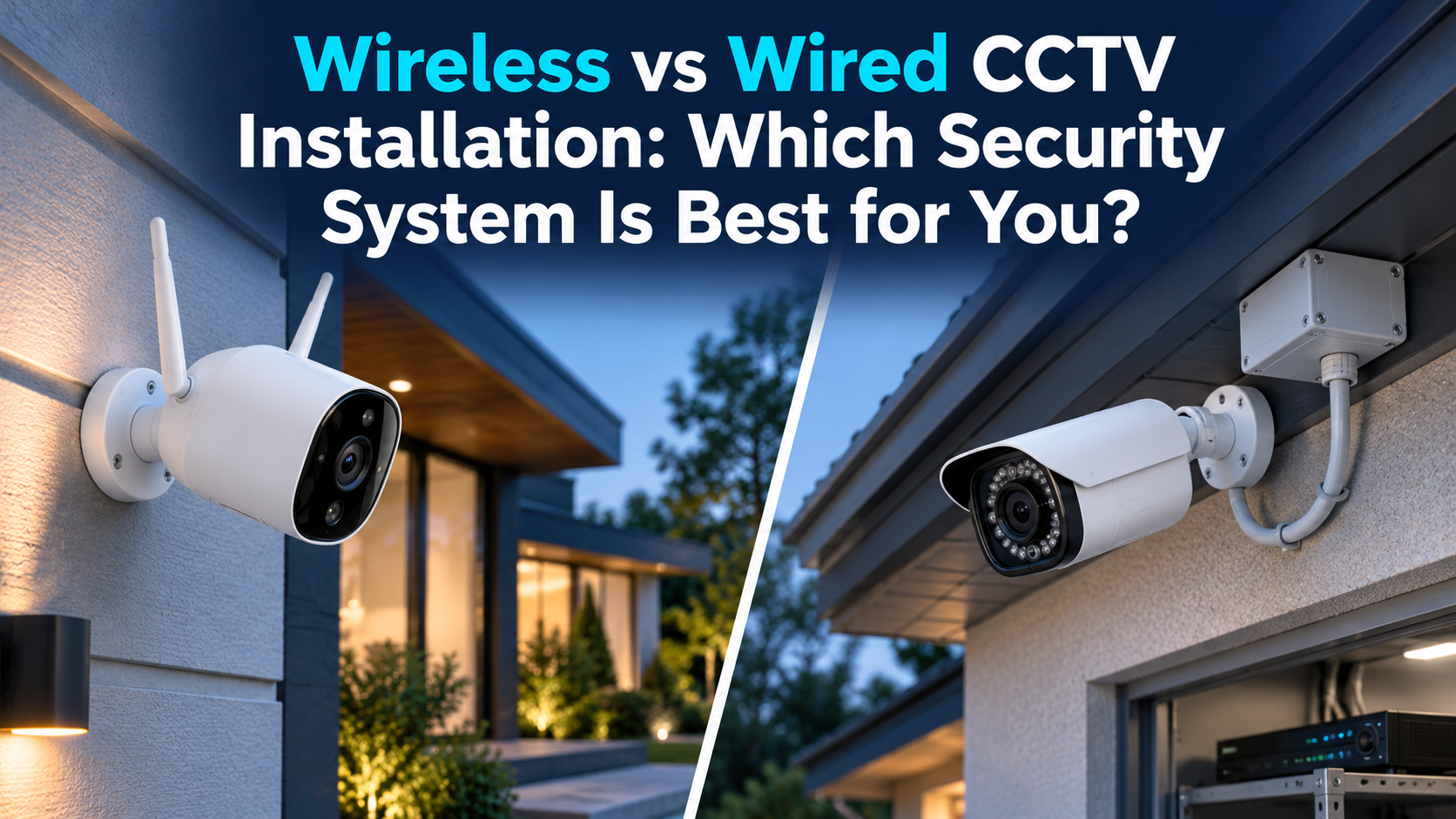
Wired and wireless systems differ in two fundamental ways: how video travels and how power reaches each camera. Wired systems use physical cabling, usually Ethernet for modern IP cameras or coaxial cable for older analog setups, to carry video back to a recorder. Wireless systems transmit video over Wi Fi or another radio frequency, though most so called wireless cameras still need a power source, whether a mains adapter or a rechargeable battery. Understanding this distinction is essential because it shapes everything from image quality and storage to cybersecurity and long term maintenance.
For property owners across Greater Manchester, CCTV installation in Tameside demands particular attention to local building stock. Tameside includes dense terraces, larger semis, newer estates, and commercial premises near the Pennine edge, and those differences directly affect cable routes, wireless coverage, and rooftop access. A terraced home in Ashton under Lyne may present very different cabling challenges from a warehouse in Hyde or a semi detached property in Denton. A professional installer should survey the actual address and building rather than applying a town wide assumption, because wireless signal behaviour and cable pathways change from street to street.
Expert perspective: “Wireless technologies simply aren’t as reliable as wired alternatives, because wireless implementations are subject to so many more variables. Atmospheric conditions and interference from outside sources can cause wireless performance to fluctuate”. This observation from a senior technology editor captures the central concern that drives many installers to recommend wired infrastructure for permanent security deployments.
Table of Contents
- Wired vs Wireless CCTV Installation: Which Offers Better Security?
- Side by Side Comparison: Reliability, Image Quality, and Cost
- The Real World Trade Offs of Wireless Convenience
- When Wired CCTV Is the Clear Choice
- When Wireless CCTV Makes Practical Sense
- Step by Step Guide to Choosing and Installing Your System
- Pre Installation Checklist
- Frequently Asked Questions
- Final Verdict: Matching the System to the Property
Wired vs Wireless CCTV Installation: Which Offers Better Security?
A wired CCTV system relies on dedicated physical connections for both video transmission and power. The most common modern configuration is Power over Ethernet, usually shortened to PoE, where a single Ethernet cable delivers both data and electrical power to each camera from a network video recorder or a PoE switch. Older analog systems use coaxial cable for video alongside a separate power cable, often bundled together as Siamese cable, and they connect to a digital video recorder rather than a network recorder. In both cases, the connection is dedicated and does not compete with other devices on the property for bandwidth or signal strength.
A wireless CCTV system transmits video over Wi Fi or a proprietary radio frequency. The term wireless is often misleading because it usually describes only the network connection, not the power supply. Many wireless cameras are plug in Wi Fi models that still require a nearby electrical outlet, while fully wire free cameras run on rechargeable batteries or solar panels. Battery powered cameras offer the greatest placement freedom, but they also introduce charging cycles, motion triggered recording limitations, and performance variations in cold weather. Plug in Wi Fi cameras sit between these extremes, offering easier installation than a full wired system while retaining a constant power source.
The choice between these architectures is not about which technology is universally superior. It is about which set of trade offs aligns with your security priorities. A wired system demands more installation labour and upfront planning, but it delivers continuous recording, stable bandwidth, and minimal ongoing intervention. A wireless system deploys quickly and flexibly, but it places your security coverage at the mercy of signal conditions, battery health, and network congestion.
Side by Side Comparison: Reliability, Image Quality, and Cost
| Feature | Wired PoE CCTV | Wireless Wi Fi or Battery CCTV |
|---|---|---|
| Connection reliability | Dedicated cable, immune to Wi Fi interference and network congestion | Dependent on signal strength, vulnerable to interference and jamming |
| Image quality under load | Sustained high bandwidth, genuine 4K with minimal compression | Heavy compression to maintain connection, 4K often resembles 1080p |
| Power supply | Continuous power over Ethernet, no batteries | Mains adapter or rechargeable batteries requiring regular charging |
| Installation complexity | Higher, requires cable routing and drilling | Lower, often DIY friendly and repositionable |
| Upfront cost | Higher for labour and cabling | Lower for hardware and basic installation |
| Long term cost | No subscription fees, minimal maintenance | Possible cloud storage fees and battery replacement costs |
| Cybersecurity | Physically isolated network, easier to quarantine and monitor | Radio frequency transmission, dependent on encryption and firmware hygiene |
| Best suited to | Permanent home and business installations requiring 24/7 recording | Rentals, temporary sites, and locations where cabling is impractical |
The reliability gap between wired and wireless is the single most consequential difference for security outcomes. Wired Ethernet connections do not suffer from Wi Fi interference, signal dropout, or bandwidth competition from other household devices, so cameras stay online and recording continuously. Wireless cameras, by contrast, depend on adequate signal coverage at the mounting location. Thick Victorian brick walls, distance from the router, and network congestion from streaming and gaming can all degrade performance or cause dropouts. In rare but documented cases, thieves have used Wi Fi jammers to deliberately disrupt wireless cameras during burglaries, a vulnerability that does not affect physically cabled systems.
Image quality follows the same pattern. Wireless cameras often compress video heavily to maintain a stable connection, which means a 4K wireless camera may deliver footage that looks closer to 1080p after compression. Wired PoE cameras on gigabit Ethernet can deliver genuine 4K footage with minimal compression, preserving the detail needed to identify faces or number plates. For evidential purposes, this difference can be decisive.
Cost is more nuanced than the sticker price suggests. Wireless systems often cost less upfront, but total cost of ownership may favour wired infrastructure over time. A basic wired four camera system may cost around £300 for supply alone, with cabling and installation adding several hundred pounds, while wireless installation labour is typically lower. However, wireless systems may carry ongoing cloud storage subscriptions, and battery powered cameras require replacement batteries and periodic charging visits. A wired system with local network video recorder storage eliminates recurring cloud fees and typically runs for many years with little more than lens cleaning. UK installation pricing for a fully fitted wired four camera system commonly falls in the range of £800 to £1,200, while wireless systems can be supplied and installed for less but may incur higher lifetime costs through subscriptions and maintenance.
The Real World Trade Offs of Wireless Convenience
Wireless CCTV appeals because it removes the most intimidating part of a security installation: running cables through walls, ceilings, and exterior masonry. For renters who cannot drill or modify the property, or for temporary situations such as monitoring a building project or a short term rental, wireless cameras offer a practical solution that would otherwise be unavailable. In genuinely inaccessible locations where the cost of running a cable would exceed the value of the camera itself, a battery powered wireless unit can provide coverage that wired infrastructure cannot economically match.
Those advantages come with a convenience tax that becomes apparent over months and years rather than days. Battery powered cameras need recharging every few weeks to months depending on activity levels, and cold weather drastically reduces battery life, a particularly relevant consideration in a northern English winter. To preserve battery, these cameras often record only when triggered by motion, which means they can miss the lead up to an incident and may be slow to wake when something actually happens. Plug in Wi Fi cameras avoid battery management but remain dependent on the quality and stability of the wireless network at the camera location.
Cybersecurity is another dimension where wireless convenience introduces risk. Poorly configured wireless cameras can expose a network even when modern encryption is enabled, and default credentials, outdated firmware, and open ports are common weak points. Wired devices can be quarantined inside a dedicated CCTV network segment, denied internet access at the firewall, and monitored with authentication controls that are much harder to enforce on equipment relying on radio transmission. For businesses handling commercial confidentiality or safeguarding responsibilities, this control over the physical and logical network boundary is often decisive.
Expert perspective from the installation trade: “For homeowners who want long term, reliable security, we recommend wired CCTV every time. The upfront cost is higher, but you get better footage, no monthly fees, and a system that works regardless of your internet connection”. This view from experienced UK installers reflects a consistent pattern across the trade: wireless is chosen for flexibility, but wired is chosen for permanence.
When Wired CCTV Is the Clear Choice
Wired CCTV is the recommended path for most permanent home installations, business premises, and any environment where reliable 24/7 recording is non negotiable. If you own the property and intend to remain there for several years, the higher upfront investment in cabling and professional installation is repaid through consistent performance and the absence of recurring fees. Wired systems are also the better choice wherever evidence quality matters, because sustained bandwidth preserves the resolution and frame rate needed for identification.
Businesses in Tameside and across Greater Manchester often fall into this category. Industrial and warehouse sites around Hyde, Dukinfield, and Ashton under Lyne frequently need coverage around shutters, yards, and delivery areas where continuous recording and tamper resistance are essential. In these environments, a wired PoE system connected to a local network video recorder offers a level of certainty that wireless cannot reliably replicate. The same logic applies to larger homes, multi camera installations, and any property where scalability is a consideration, because adding a camera to a wired system simply means running one more cable to the recorder or switch.
When Wireless CCTV Makes Practical Sense
Wireless CCTV is not a compromise to be dismissed. It is the right tool for specific situations where cabling is genuinely impractical or where the installation is temporary by design. Renters who cannot modify the fabric of the building, landlords monitoring short term lets, and project managers overseeing construction sites all benefit from the rapid deployment and removal that wireless systems provide. Wireless also works well as a supplementary layer, adding a quick view of a distant shed or an awkward corner without the cost and disruption of a full cable run.
The key is to choose the right type of wireless system for the context. Plug in Wi Fi cameras are generally more dependable than battery powered units because they do not depend on battery health and can record continuously when required. Battery powered cameras should be reserved for locations where power is genuinely unavailable and where motion triggered recording is acceptable. A hybrid approach, combining wired cameras for critical permanent positions and wireless cameras for secondary or temporary coverage, is increasingly common and allows a single recorder or management platform to oversee both types.
Step-by-Step Guide to Choosing and Installing a CCTV System
Choosing the right CCTV system involves understanding your security needs, assessing your property, and planning the installation carefully. Follow these steps to select a system that provides reliable coverage and long-term value.
1. Identify Your Security Requirements
Start by deciding what you want your CCTV system to achieve. You may need 24/7 recording, motion detection, number plate recognition, or remote monitoring. Wired systems are often suitable for continuous recording, while wireless cameras can offer flexibility for smaller properties and temporary coverage.
2. Assess Your Property and Camera Locations
Identify the areas that require monitoring and check whether cables can be routed to each camera location. For wireless systems, test Wi-Fi signal strength and consider obstacles such as thick walls, metal structures, and long distances from the router. Every property requires an individual assessment to ensure effective coverage.
3. Choose Your Recording and Storage Options
Wired CCTV systems commonly use a network video recorder (NVR) or digital video recorder (DVR), depending on the camera technology. Wireless cameras may use local storage, a dedicated hub, or cloud storage. Compare storage capacity, subscription fees, remote access, and backup options before making a decision.
4. Request a Professional CCTV Installation Quote
A professional installer can assess your property and recommend a suitable system based on your security requirements and budget. Ask for a detailed quotation covering cameras, recording equipment, cabling, labour, and ongoing costs. For wired systems, ensure cable connections are tested and outdoor installations are properly weatherproofed.
5. Plan the Installation Process
Wired CCTV installation may require drilling, cable routing, and additional preparation. Confirm how cables will be concealed or protected from weather and damage. Wireless systems generally require less cabling, but camera placement remains important for reliable connectivity, clear images, and effective coverage.
6. Secure Your CCTV System and Remote Access
Change default passwords, install firmware updates, and enable strong encryption where available. Use secure remote-viewing applications and enable two-factor authentication if supported. These precautions help protect both wired and wireless systems from unauthorised access.
7. Test Camera Coverage and Recording
Once installation is complete, test every camera during daylight and at night. Check image clarity, recording playback, motion detection, and mobile alerts. For battery-powered cameras, monitor battery performance and establish a suitable charging routine to avoid interruptions.
8. Review System Performance After Installation
Review your CCTV system after the first month to identify blind spots, unnecessary motion alerts, or connectivity issues. Adjust camera angles, detection zones, and recording settings as needed. Regular checks and maintenance can help keep your security system operating reliably over time.
Pre Installation Checklist
Before committing to a CCTV installation, work through the following checks to ensure your chosen system matches your needs and your property.
☑ Confirm whether you need continuous 24/7 recording or motion-triggered clips only.
☑ Identify the exact camera positions and verify cable routes or wireless signal strength at each location.
☑ Decide whether to use local or cloud storage and compare the three-year cost of each option.
☑ Check whether existing coaxial or Ethernet cabling can be reused.
☑ Verify that the recorder location has adequate power, ventilation, and network connectivity.
☑ Ensure the installer provides a property-specific site survey rather than a standard package.
☑ Ask how the system will be protected against unauthorised access, including password security and firmware updates.
☑ Clarify the maintenance services included and any ongoing costs.
☑ Check compliance with relevant UK regulations and data protection guidance, particularly if cameras capture public areas.
☑ Agree on a final walkthrough and handover so you know how to view, export, and manage recorded footage.
Frequently Asked Questions
Can a wireless CCTV camera work without an internet connection?
A wireless camera needs a network to transmit video, but not necessarily the public internet. Some wireless systems use a dedicated base station or a local recorder and can continue recording locally even if the broadband connection fails. However, cloud dependent cameras may stop recording or stop sending alerts when the internet goes down. If resilience during broadband outages is important, choose a system with local recording and a local power supply.
How long do wireless CCTV batteries actually last?
Battery life varies widely with resolution, recording frequency, temperature, and motion activity. Most battery powered cameras operate for two to six months per charge, but high resolution cameras that record frequently will deplete faster, and cold weather significantly reduces capacity. If you choose battery powered cameras, plan a charging routine and consider solar accessories only where reliable sunlight is available.
Is wired CCTV more expensive than wireless in the long run?
Wired systems usually cost more upfront because of cabling and installation labour, but they often cost less over three years once wireless cloud subscriptions, battery replacements, and maintenance visits are included. A wired system with local recorder storage typically has no mandatory recurring fees, whereas many wireless cameras depend on subscription plans for cloud storage and advanced features.
Can I install wireless CCTV myself?
Plug in Wi Fi cameras are generally the most DIY friendly option because they do not require cable runs and often use a smartphone app for setup. However, DIY installation still requires careful camera positioning, secure password configuration, and a stable Wi Fi signal at each location. Battery powered wire free cameras are also relatively easy to mount, but they require an ongoing charging routine and may not deliver the continuous recording that a professionally installed wired system provides.
Which system is better for a Tameside property with thick stone or brick walls?
Thick masonry is one of the strongest arguments for wired CCTV. Wi Fi signal degrades significantly through solid brick and stone, and a router inside the property may struggle to reach cameras mounted on exterior walls or in outbuildings. A wired PoE system avoids this problem entirely because the connection is physical. For Tameside properties with challenging construction, a professional survey should test signal at each proposed wireless location before committing to a wireless design.
Final Verdict: Matching the System to the Property
There is no single answer to the wireless versus wired question that applies to every property, but there is a reliable decision framework. Choose wired PoE CCTV when the installation is permanent, when continuous recording and evidential image quality matter, when the property has thick walls or difficult Wi Fi conditions, and when you want to avoid recurring cloud fees and battery maintenance. Choose wireless when the installation is temporary or rental based, when cabling is genuinely impractical, or when you need to supplement an existing wired system with additional coverage in awkward locations.